

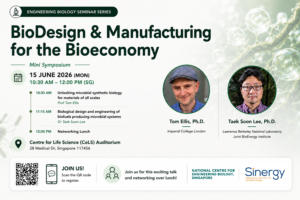
This seminar brings together perspectives from Prof Tom Ellis, Professor in Synthetic Genome Engineering at Imperial College London, and Dr Taek Soon Lee, staff scientist at Lawrence Berkeley National Laboratory and a Director of Metabolic Engineering at Joint BioEnergy Institute.
Abstract:
Unlocking microbial synthetic biology for materials of all scales
Synthetic biology offers a new opportunity to learn how to write DNA programs that make new materials with diverse functions and properties. Our group engineers classical model organisms like yeast and E. coli, but now also works with microbes proficient in producing the base polymer of all plants – cellulose. Using synthetic biology and cellulose-producing bacteria isolated from kombucha, we’ve been developing work over the past decade that has applications in healthcare, pollution remediation, food, fashion and textiles. We’ve begun to understand more about cellulose-producing bacteria and which other microbes they can collaborate with, and we’re now bringing work from chemical biology into our research too. As we expand this work, the opportunities to collaborate with people in SE Asia is important, as this is one of the ideal places for manufacturing materials from microbes such as the Kombucha bacteria that we work with.
Biological design and engineering of biofuels producing microbial systems
Single-cell microbes, such as E. coli and yeast, can be redesigned to be miniature chemical reactors that transform sugars into biofuels and biochemicals. With the development of synthetic biology, we can design biological systems, introduce biosynthetic pathways from one organism into new host organism, and engineer metabolic pathways using genetic manipulation to optimize the production of target biofuels and biochemicals that the host microbe does not naturally generate. Isoprenoids are naturally occurring hydrocarbons with a branched, and in many cases, a cyclic structure. They are produced mostly by plant and have been used traditionally as medicine and fragrance ingredients. However, recently the use of these molecules as biofuels has been explored and has shown a great possibility. We designed and identified isoprenoid compounds that can be potentially used as fuels, and engineered the heterologous biosynthetic pathway into model host, E. coli, to produce these terpene compounds with a relatively high yield. To achieve higher production titer of these terpene molecules, we have optimized the pathway to accumulate the precursors using synthetic biology and advanced Omics. We also addressed the challenge of metabolic engineering to achieve high production titer using synthetic biology and advanced Omics by coupling laboratory automation, Machine Learning (ML), fit-for-purpose multiplexed CRISPR interference (CRISPRi), and high-throughput analytical techniques to rapidly optimize production of isoprenol in Pseudomonas putida. The simultaneous downregulation of gene target combinations using CRISPRi arrays, guided by ML, permitted us to increase isoprenol titer 5-fold in six consecutive DBTL cycles. In summary, we will show our efforts to create highly efficient microbial factories for green, cost-effective and sustainable production of advanced biofuels and other valuable products.
Biography:
Tom Ellis is a Professor in the Department of Bioengineering and Co-Director of the Centre for Engineering Biology at Imperial College London. Tom has a degree in Molecular Biology from Oxford University and a PhD from Cambridge University. After university Tom worked in a biotech company in London, then spent 2 years as a postdoc at Boston University before starting his own research group in 2010 at Imperial College London. His group work on synthetic biology with their research treating DNA as the programming language for life. By editing and rewriting the DNA programs in cells his team direct cells to do new tasks useful for modern biotechnology. The Ellis Lab specialises in developing synthetic biology and genome engineering tools for yeasts and bacteria and they apply these tools in projects to make synthetic cells and recoded organisms that can make and release therapeutic molecules, sense and respond as living sensors and can autonomously grow new functional materials.
Dr. Taek Soon Lee is a Staff Scientist at Lawrence Berkeley National Laboratory and a Director of Metabolic Engineering at Joint BioEnergy Institute. Dr. Lee earned a B.S. in Chemistry at Seoul National University (Korea) and a Ph.D. in Chemistry at Stanford University in 2006 studying type II aromatic polyketide synthases with Professor Chaitan Khosla. After a postdoctoral training at University of California with Professor Jay D. Keasling, Dr. Lee became a career Scientist at Lawrence Berkeley National Laboratory in 2008 and joined as a Director of Metabolic Engineering at the Joint BioEnergy Institute (JBEI)
Dr. Lee’s research group is focusing on identifying potential drop-in biofuels and building and optimizing the metabolic pathway to produce these target fuels in microbes. Major target fuels are isoprenoid-based compounds that can be alternative to gasoline, jet, and diesel fuels. To improve fuel production titer, rate, and yield (TRY), Dr. Lee’s group studies the producing host and fuel biosynthesis pathway intensively using various functional genomics tools such as targeted proteomics, metabolomics, and transcriptomics, and engineer the metabolic pathway in the producing host using synthetic biology tools and systems biology.