

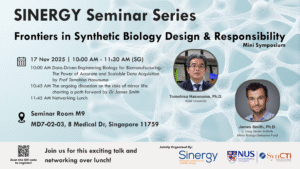
Frontiers in Synthetic Biology Design & Responsibility
Synposis:
Data-driven Engineering Biology for Biomanufacturing: The Power of Accurate and Scalable Data Acquisition
Engineering biology is attracting great expectations from society as an academic field that contributes to solving global issues and furthering economic development. The basic concept of engineering biology is the design and construction of biological systems with novel functions, which will lead to a better understanding of the mechanisms of life, but also the realization of valuable industrial applications in fields such as chemistry, energy, medicine, and food.
Our research group is developing novel capabilities in the theme of bioengineered cells and systems, applying metabolic engineering of microbes for high-value chemical production, as there is a great deal of industrial interest in biomanufacturing using microorganisms. Recent advances in genome synthesis and engineering, high-throughput technologies, measurement technologies, and computational science have enabled the faster and more reliable implementation of increasingly ambitious design strategies. We launched a bio-foundry approach for rapid engineering of model microorganisms, and we have succeeded in developing Escherichia coli and yeast strains that can produce high amounts of useful molecules.
Kobe University Engineering Biology Research Center (EGBRC) is working on the development of “Smart Cells,” a microbial strain that can produce high amounts of useful substances using computer-designed metabolic pathways and enzymes. In particular, what determines the quality of the design is the experimental data and the analysis and evaluation technology that generates it. Thus, we are developing high-throughput screening technology using supercritical fluids and metabolomics that achieves high reproducibility by automating the pretreatment process. In addition, we have also developed a DBTL platform for enzyme engineering. In this session, I would like to introduce our “Smart Cell Development Platform” incorporating the elemental technologies we developed and look into the future of bioengineering.
The ongoing discussion on the risks of mirror life: charting a path forward
In December 2024, a group of 38 leading scientists published an analysis in Science describing the risks of mirror bacteria: self-replicating synthetic organisms composed of molecules with the opposite chirality of their naturally occurring counterparts. Mirror bacteria could plausibly be created in the next 10-30 years, and their reversed chirality could enable them to evade common mechanisms used in immunity and predation, posing potentially unprecedented risks to humans, animals, plants, and ecosystems. The authors argued that global discussion is needed and recommended that mirror bacteria should not be created. This talk will summarize ongoing discussions about the feasibility of creating mirror life, its risks and potential benefits, and the potential for developing governance while preserving the benefits of related technologies.
Biography:
Tomohisa Hasunuma is the Director of Engineering Biology Research Center, and concurrently serves as a Professor at the Graduate School of Science, Technology and Innovation at Kobe University, Japan. He earned his B.Sc. (1998), M.Sc. (2000) and PhD (2004) in the Department of Biotechnology at Osaka University, Japan. In 2004, Dr. Hasunuma joined Research Institute of Innovative Technology for the Earth (RITE), before transitioning to Kobe University in 2008. From 2011 to 2014, he held the position of the Researcher for Precursory Research in Embryonic Science and Technology (PRESTO) under the Japan Science and Technology Agency. Dr Hasunuma has led major biotech-related projects in Japan, including those funded by NEDO and JST. Currently, as the director of the Bio-Manufacturing Collaborative Research Center at Kobe University, he is dedicated to forming an ecosystem for industry-government-academia collaboration related to bio-manufacturing. Dr. Hasunuma has authored over 230 peer-reviewed journal papers and 90 reviews and book chapters, and has filed more than 60 patents. His research focuses on engineering biology of microorganisms such as yeast, Escherichia coli, cyanobacteria and microalgae with a particular emphasis on metabolic engineering based on metabolism analysis for the production of biofuels, commodity chemicals and highly functional compounds from renewable biomass and carbon dioxide.
—
James Smith, DPhil, is an Adjunct Associate Professor at the J. Craig Venter Institute and the Deputy Director of the Mirror Biology Dialogues Fund, where he works to further the conversation around the potential risks associated with mirror life. He was a co-author of the 2024 Science article “Confronting risks of mirror life”. Dr. Smith has worked in think tanks on biotechnology policy, and in industry as Head of Global Strategy for a company developing COVID-19 and influenza vaccines and as a consultant. Dr. Smith did graduate and post-doctoral research at the University of Oxford.